
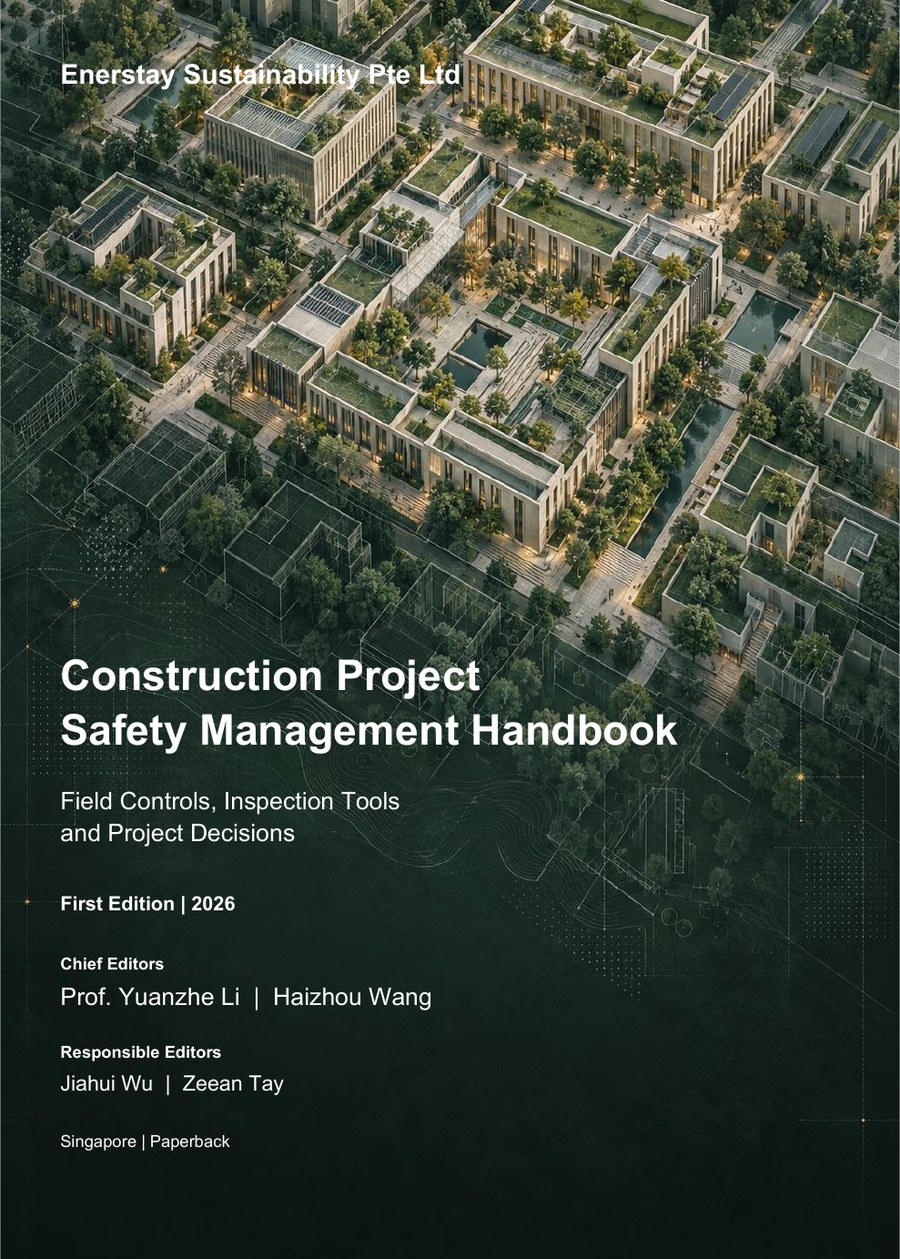
Construction Project Safety Management Handbook
Field Controls, Inspection Tools and Project Decisions
- Chief editors
- Prof. Yuanzhe Li · Haizhou Wang
- Responsible editors
- Jiahui Wu · Zeean Tay
- Publication
- Singapore · 2026 · Paperback
- Language and extent
- English · 297 pages
From the book
Preface
Construction safety depends on decisions about design, procurement, sequencing, people and the condition of the workfront. This handbook connects those decisions with practical methods for preparing work, checking critical controls and responding when conditions change.
The book follows a project from partner selection and design through mobilisation, construction, commissioning and closeout. Each chapter opens with a field operating guide. Technical notes deepen occupational exposure control and high-risk construction work. The companion Field Inspection and Decision Forms provides editable records for readiness, inspections, changes, corrective action and handover.
The principal readers are project and construction managers, supervisors, WSH professionals, designers and contractors. They can enter the book through a task, a failed control or a required decision. The detailed explanations, calculations and professional learning questions provide supporting depth.
Singapore provides the principal legal context. Use in other Southeast Asian jurisdictions requires local verification of duties, professional appointments, permits, technical requirements and reporting arrangements. International technical sources are identified by origin and do not establish Singapore law.
Illustrative projects, scenarios and numerical examples are identified as such. They are not claims of observed project performance. Documented Singapore cases are distinguished from the accompanying analysis and fictional application exercises.
Chapters 1–3 establish the management and legal foundations. Chapters 4–14 address project preparation and control; Chapters 15–26 address competence, health, assurance, emergencies, environment and handover. Chapters 27–34 examine high-risk work. Appendices retain the references, integrated exercise, glossary, decision templates, learning answers and subject index.